
Apache Druid
Apache Druid is a real-time OLAP database that delivers sub-second queries on streaming and batch data for analytics at scale.
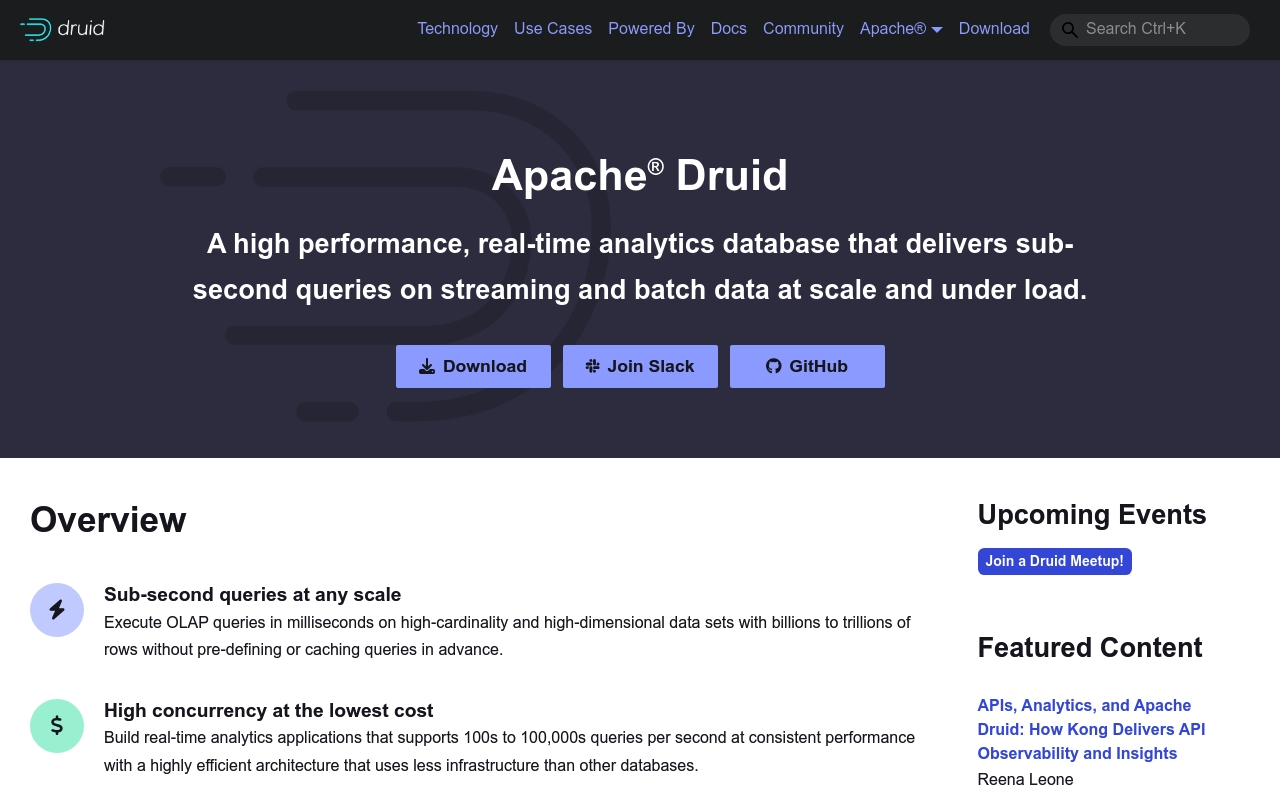
Apache Druid is a high-performance, real-time OLAP database built for sub-second analytics on event-driven data.
Key Features:
- Streaming Ingestion - Ingest data from Kafka, Kinesis, and other streams for real-time analysis.
- Column-Oriented Storage - Compress and index data for fast scans and aggregations.
- Tiered Storage - Automatically move historical data to cost-effective deep storage.
- Rich Aggregations - Approximate distinct counts, histograms, and quantiles at query time.
Whether you're analyzing scraping event streams, building real-time monitoring dashboards, or querying large crawl datasets, Apache Druid provides the speed and scale for interactive analytics.
Web scraping workflow
How to use Apache Druid in a web scraping pipeline
Apache Druid ingests source data into segments for analytical queries. In a scraping operation, it can summarize timestamped collection events or repeated observations rather than acting as the crawler itself.
A practical workflow
- Emit a structured event from your scraper containing collection time, source, outcome and selected measurements.
- Send those events through a supported batch or streaming ingestion path, defining the timestamp, dimensions and metrics deliberately.
- Query Druid to examine failure trends, collection coverage or changes across time windows and feed an operational dashboard.
When it fits
This pattern suits time-oriented monitoring and analysis of a continuing collection process. Separating event telemetry from the full extracted document keeps the analytics model focused on the questions operators actually ask.
Boundaries
Druid does not fetch or parse web pages. Ingestion, segment storage and schema configuration remain operational responsibilities. Rollup and aggregation choices can remove detail needed later, so retain canonical records or raw captures separately when exact reconstruction or individual-page investigation is required.
Growing a website? Track its keywords, Google rankings, Search Console insights, and share of voice with bisibility. Free during beta.
Our productRepository
apache/druid
Stars
14.1KForks
3.8KLast commit
2026-10-15License
Apache-2.0Language
Java
Metrics recorded 2026-10-16
Repository details
License source: Repository license file
Frequently asked questions
What is Apache Druid used for?
Apache Druid is an analytical database for aggregating and exploring event data. It supports real-time ingestion and queries over timestamped datasets, including dashboards and operational analytics. Its distributed design separates ingestion, storage and query responsibilities.
Sources (checked ): Apache Druid design
How does Apache Druid work?
Druid ingests data into column-oriented segments, partitions it by time and executes queries through distributed services. Segments are stored in deep storage and made available to query-serving processes. Its indexes and query processing are designed for analytical filtering and aggregation.
Sources (checked ): Apache Druid design
Is Apache Druid NoSQL?
Druid is a column-oriented analytical database that supports SQL and native JSON queries. Its main workload is analytical querying, rather than conventional transactional OLTP.
Sources (checked ): Apache Druid design; Apache Druid SQL; Apache Druid querying
Is Apache Druid a data warehouse?
Druid supports event-oriented interactive analytics, including real-time dashboards and slice-and-dice queries. It ingests timestamped data into columnar segments and uses deep storage. This design and its data-management features differ from those of a general-purpose warehouse.
Sources (checked ): Apache Druid design; Apache Druid SQL
What are the disadvantages of Apache Druid?
A Druid deployment has multiple services and storage components to operate. Time partitioning, segment design and ingestion settings affect query behavior and resource use. Its SQL and native query capabilities also have their own supported features, so check requirements that assume another database’s behavior.
Sources (checked ): Apache Druid design; Apache Druid SQL; Apache Druid querying
Sources
Verified against the apache/druid repository and the PyPI package.