

AWS Lambda
AWS Lambda runs code without managing servers, ideal for event-driven scraping pipelines triggered by schedules, queues, or API calls.
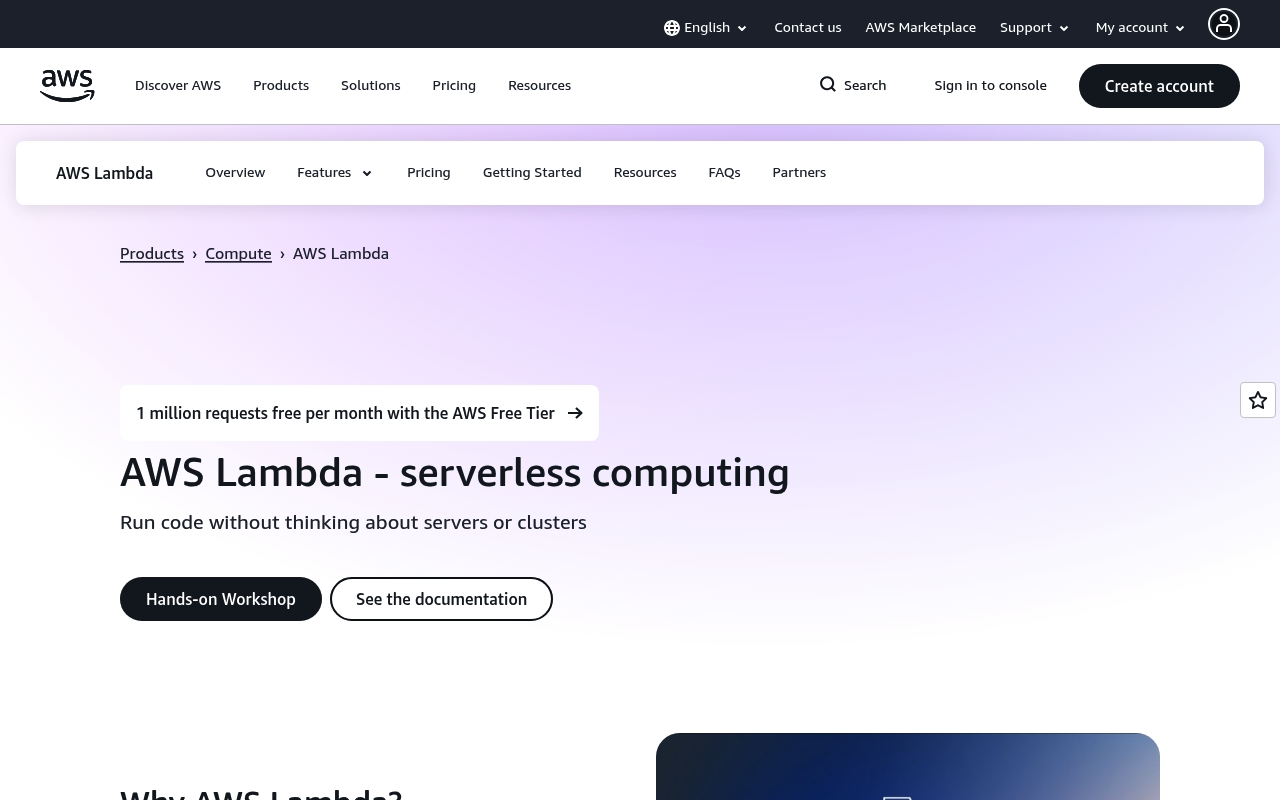
AWS Lambda is a serverless compute service that runs code in response to events without provisioning or managing servers.
Key Features:
- Event-Driven Execution - Trigger scraping functions from schedules, S3 uploads, SQS messages, or API calls.
- Auto-Scaling - Scale from zero to thousands of concurrent executions automatically.
- Pay-Per-Use - Pay only for the compute time consumed, with a generous free tier.
- AWS Integration - Connect seamlessly with S3, DynamoDB, SQS, and Step Functions for complete pipelines.
- Multi-Runtime Support - Run scrapers in Python, Node.js, Java, Go, or custom container images.
Whether you're building scheduled scrapers, processing crawl results, or orchestrating data pipelines, AWS Lambda provides scalable, cost-effective serverless compute.
Web scraping workflow
How to use AWS Lambda in a web scraping pipeline
AWS Lambda runs application code without requiring you to operate a dedicated server. A scraping pipeline can use a function for bounded acquisition or processing tasks whose runtime and dependencies fit the chosen Lambda execution environment.
A practical workflow
- Send a function a small URL batch or a reference to an already stored capture.
- Your handler runs an HTTP fetcher or parser, validates the output and writes accepted records and raw artifacts to external storage.
- Return a compact result reference and let a separate coordinator schedule additional batches or handle failures.
When it fits
Consider it for discrete collection or processing steps in an AWS application. Keeping batches bounded makes timeouts and partial failures easier to manage than putting a whole site's crawl into one invocation.
Boundaries
Lambda is compute, not a managed scraper. Browser binaries and libraries need an appropriate package or container, and execution limits depend on the selected mode. Preserve progress externally, make writes safe to repeat and configure timeout, memory, network access and request pacing for the actual task.
Frequently asked questions
What is AWS Lambda used for?
AWS Lambda runs functions in response to events, including API requests, queues and changes in other AWS services. AWS operates the execution infrastructure; your application provides code, dependencies and configuration.
Sources (checked ): Lambda introduction
What are the limitations of AWS Lambda?
Standard Lambda invocations have a 15-minute (900-second) timeout. Managed Instances can allow up to 90 minutes for asynchronous invocations and event-source mappings other than Amazon MQ and Amazon DocumentDB. Memory, payload and concurrency quotas also depend on the execution mode and invocation type.
Sources (checked ): Lambda quotas
Can AWS Lambda run Python?
Yes. Lambda supports documented Python runtimes. Supply a handler and package the dependencies your function needs; runtime versions and package compatibility determine the deployment configuration.
Sources (checked ): Lambda Python runtimes
How much does AWS Lambda cost?
Lambda charges depend on the execution mode and resources used. Request counts, execution duration, memory and optional features affect the bill. Free allowances or account credits have limits, and connected AWS services can incur separate charges.
Sources (checked ): Lambda pricing
Similar to AWS Lambda

Sources
Verified against the official AWS Lambda website and documentation.