
ClickHouse
ClickHouse is a fast, open-source columnar database that runs analytical queries on billions of scraped records in milliseconds.
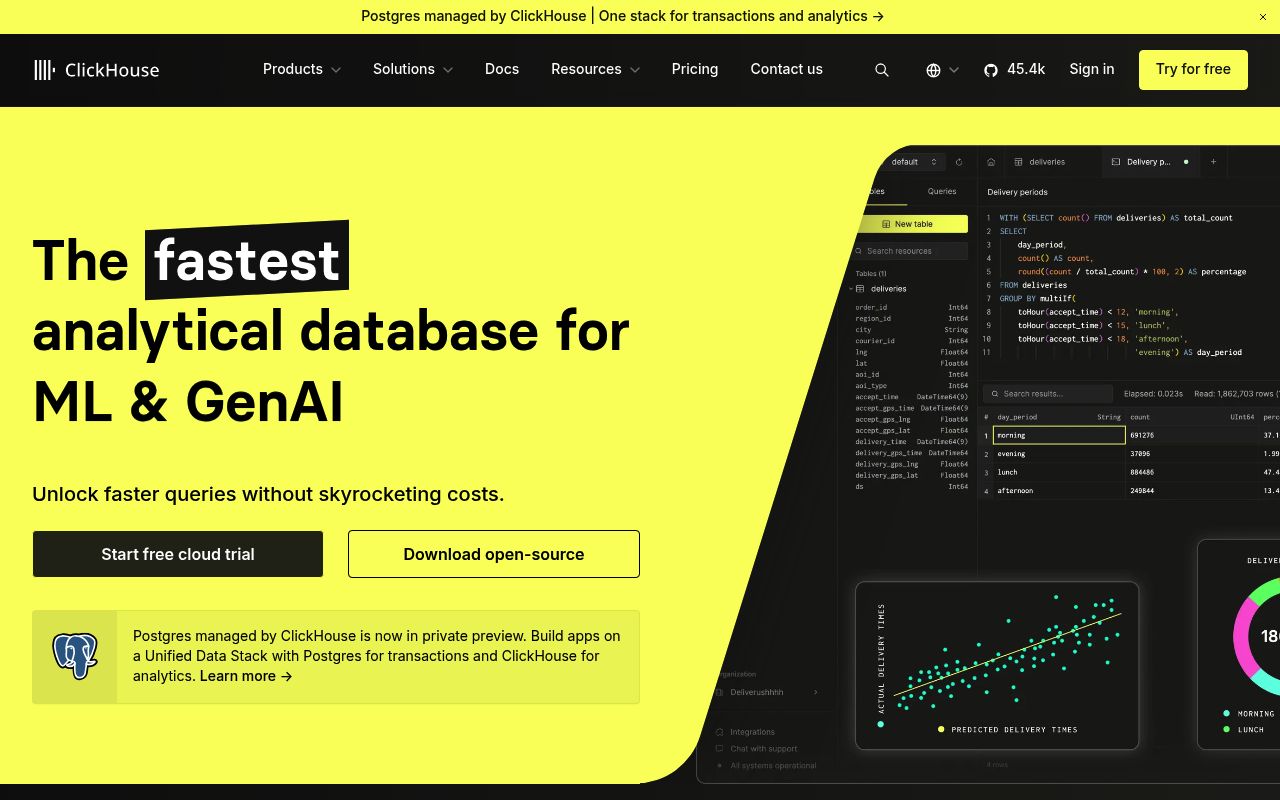
ClickHouse is a fast, open-source columnar database built for real-time analytics at petabyte scale.
Key Features:
- Column-Oriented Storage - Compress and query only the columns you need for maximum efficiency.
- SQL Interface - Use standard SQL to explore scraped datasets without learning new query languages.
- Real-Time Ingestion - Stream scraped data directly into tables and query it immediately.
- Horizontal Scaling - Distribute data across nodes to support larger workloads.
Whether you're analyzing crawl metrics, building real-time dashboards, or aggregating scraped e-commerce data, ClickHouse delivers the speed and scale your analytics demand.
Web scraping workflow
How to use ClickHouse in a web scraping pipeline
ClickHouse is a column-oriented analytical database. A scraping pipeline can load normalized observations into it to compare collections over time and aggregate results across sources.
A practical workflow
- A separate scraper exports typed records with source, collection time and an entity identifier.
- Your loader batches those observations into ClickHouse tables designed for the filters and aggregations you need.
- SQL queries produce summaries such as missing-field counts, catalog changes or observations per source for a dashboard or downstream export.
When it fits
Use it when analysis spans many collected records rather than serving one transactional page update at a time. Keeping observation time distinct from a page's own published date makes historical comparisons easier to interpret.
Boundaries
ClickHouse does not render websites, select fields or automatically reconcile entity identity. Table engines, sorting keys, duplicate handling and retention are design choices. Preserve raw captures externally when reproducibility matters, and validate incoming types before treating a successful load as a trustworthy dataset.
Quick verdict
ClickHouse fits teams analyzing large scraped datasets with fast SQL analytics. It is not a crawler, browser automation tool, extraction API, or proxy layer.
- Best for
- Large scraped data analytics
- Real-time crawl dashboards
- Open-source SQL infrastructure
- Columnar storage at scale
- Not ideal for
- Turnkey scraping APIs
- Small page archives
- Browser automation workflows
- Last verified
- Jun 26, 2026
Key facts
- RepoC++ project, Apache-2.0 licenseGitHub
- Python package10,454,274 monthly PyPI downloads for clickhouse-connectPyPI
- JS package4,490,864 monthly npm downloads for @clickhouse/clientnpm
- SDKsPython, JavaScript, Go, Java, Rust, and C# clientsProject docs
Growing a website? Track its keywords, Google rankings, Search Console insights, and share of voice with bisibility. Free during beta.
Our productRepository
ClickHouse/ClickHouse
Stars
50.4KForks
9.1KLast commit
2026-10-15License
Apache-2.0Language
C++
Metrics recorded 2026-10-16
Repository details
License source: Repository license file
Frequently asked questions
What is ClickHouse used for?
ClickHouse is a column-oriented SQL database designed for analytical queries over large datasets. It is used for aggregations, reporting and real-time analytics. Its storage layout is optimized for reading selected columns across many rows.
Sources (checked ): ClickHouse introduction
Can I self-host ClickHouse?
Yes. The open-source server can run on your own infrastructure under Apache 2.0. Follow the installation instructions for your operating system and manage storage, backups, security and upgrades yourself. ClickHouse Cloud is a separate managed option.
Sources (checked ): ClickHouse installation; ClickHouse Apache 2.0 license
What are the disadvantages of ClickHouse?
ClickHouse is built for analytical queries rather than typical row-by-row transactional access. Column-oriented storage suits scanning and aggregating columns, while applications centered on frequent individual-row changes should assess those requirements separately.
Sources (checked ): ClickHouse introduction
How much does ClickHouse cost per month?
Self-hosted ClickHouse has no open-source software subscription fee, but infrastructure and operations cost money. ClickHouse Cloud charges for compute, storage and other usage and offers introductory trial credits. A trial is different from an ongoing free Cloud tier. Estimate costs from your workload and selected service tier.
Sources (checked ): ClickHouse Apache 2.0 license; ClickHouse Cloud pricing
Does ClickHouse have a GUI?
Yes. Self-hosted ClickHouse includes a web query interface at /play on its HTTP endpoint. ClickHouse Cloud also provides a managed SQL console. Access depends on the server’s interface, authentication and handler configuration.
Sources (checked ): ClickHouse HTTP web interface; ClickHouse Cloud SQL console
Sources
Verified against the ClickHouse/ClickHouse repository and the PyPI package.
Source notes
Compiled from public repository, docs, and package registry data; check ClickHouse for current details.