
Dagster
Dagster is a data orchestration platform that helps teams build, schedule, and monitor reliable data pipelines with integrated lineage and observability.
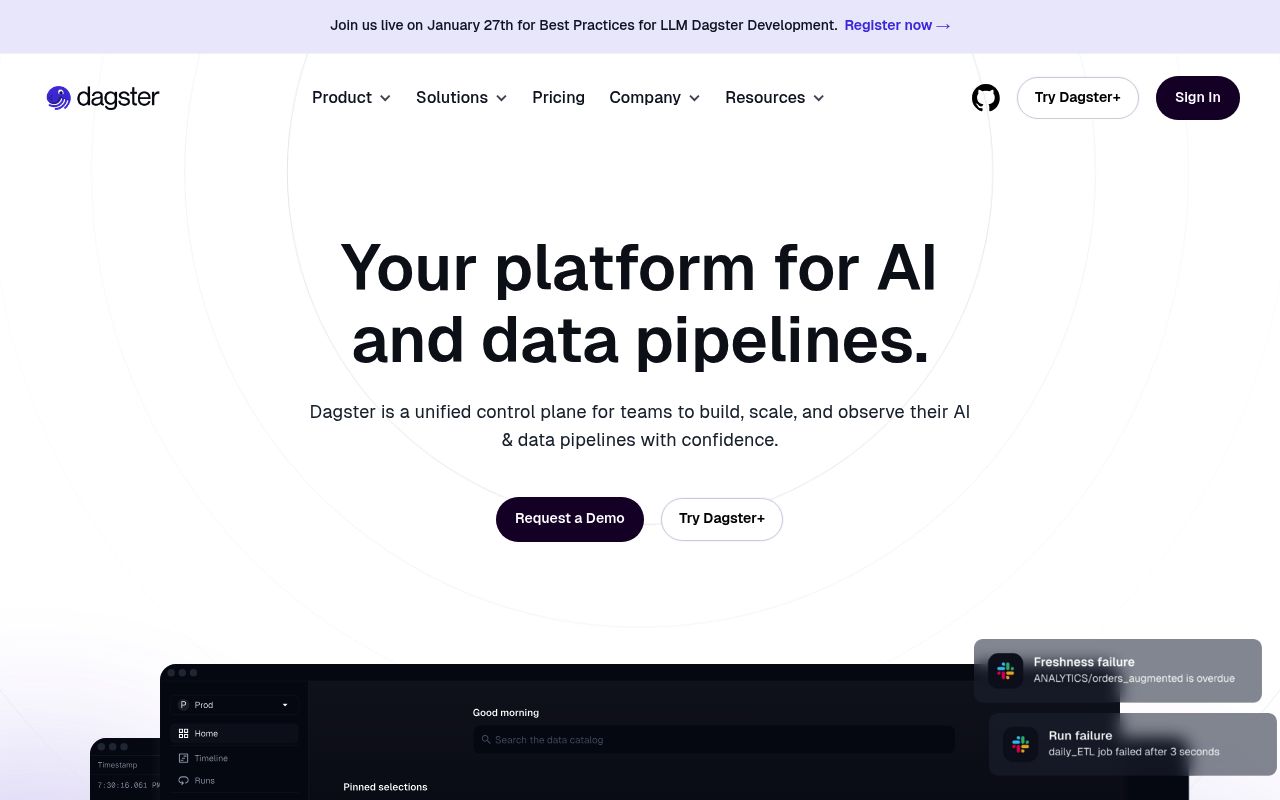
Dagster is a modern, comprehensive data orchestration platform that provides a unified control plane for building, scaling, and observing AI and data pipelines. Trusted by teams worldwide, Dagster brings together ETL, transformation, and ML workflows in one place.
Key Features:
- Asset-Based Orchestration - Model pipelines as data assets with automatic lineage tracking
- Integrated Observability - Built-in monitoring, alerting, and real-time health metrics
- dbt Integration - Orchestrate dbt, Databricks, and Python transformations natively
- Data Catalog - Auto-generated documentation with clear ownership and lineage
- AI-Powered Debugging - Intelligent alerts and impact analysis for faster issue resolution
Whether you're an analytics engineer, ML practitioner, or data team lead, Dagster provides the platform to orchestrate pipelines with confidence.
Web scraping workflow
How to use Dagster in a web scraping pipeline
Dagster models data assets and the dependencies used to produce them. In a scraping pipeline, that makes a raw capture, a cleaned table and a published dataset distinct outputs rather than hidden steps inside one collection script.
A practical workflow
- Define an asset whose code runs a separate HTTP or browser fetcher and saves a dated capture manifest.
- Define downstream assets that parse those captures, validate their schema and construct a queryable table.
- Materialize the required asset chain and retain the capture references needed to trace a row back to its source run.
When it fits
This pattern helps when scraped data is a maintained dataset with several consumers. Separate asset boundaries let the team discuss whether the raw acquisition, extraction or final dataset needs rebuilding after a change.
Boundaries
Dagster orchestrates the code you supply; it is not a managed scraping endpoint. Browser setup, network controls, storage and extraction correctness remain your responsibility. Avoid putting raw documents into orchestration metadata, and make repeated materialization safe for the destination table.
Growing a website? Track its keywords, Google rankings, Search Console insights, and share of voice with bisibility. Free during beta.
Our productRepository
dagster-io/dagster
Stars
16.3KForks
2.4KLast commit
2026-10-12License
Apache-2.0Language
Python
Metrics recorded 2026-10-16
Repository details
License source: Repository license file
Frequently asked questions
What is Dagster used for?
Dagster orchestrates data pipelines around assets and their dependencies. It tracks materialization—the creation or update of data assets—along with lineage and execution so teams can define, test and observe how data is produced.
Sources (checked ): Dagster documentation
Is Dagster Python based?
Yes. Dagster’s framework and definitions use Python, including assets, resources and jobs. Those definitions can invoke external tools and services; they do not require every data-processing system in the pipeline to be implemented in Python.
Sources (checked ): Dagster documentation; Dagster installation
Is Dagster an ETL tool?
Dagster coordinates pipelines that can perform ETL or ELT. Your assets and integrations implement or invoke the extraction, transformation and loading steps; Dagster manages their dependencies and execution.
Sources (checked ): Dagster documentation
Can you run Dagster locally?
Yes. The official quickstart sets up a Python project and runs a local Dagster development server. This is a development setup; production deployments require their own execution, storage and operational configuration.
Sources (checked ): Dagster local quickstart; Dagster installation
Does Dagster have a UI?
Yes. Dagster’s web interface shows assets, runs and execution details and lets you launch pipeline work. Dagster+ also provides a managed platform interface.
Sources (checked ): Dagster local quickstart; Dagster+ deployment
Is Dagster open source?
The Dagster framework is Apache-2.0 licensed. Self-hosting has infrastructure and operating costs, while Dagster+ is a separately priced managed service with plan-dependent features.
Sources (checked ): Dagster Apache license; Dagster pricing
What are the key differences between Apache Airflow and Dagster?
Airflow organizes scheduled workflow tasks as DAGs. Dagster emphasizes data assets, dependencies and materializations, with integrated lineage and testing support. Compare the workflow model and operational features your pipeline requires.
Sources (checked ): Dagster documentation; Airflow documentation
What are the key differences between Dagster and Dagster+?
Dagster is the framework you can operate yourself. Dagster+ adds a managed control plane and platform features; Serverless executes your code in the vendor’s environment, while Hybrid connects an execution environment you operate. Responsibilities and features depend on that deployment choice.
Sources (checked ): Dagster documentation; Dagster+ deployment
Sources
Verified against the dagster-io/dagster repository and the PyPI package.