
dbt
dbt empowers data teams to transform, test, and document data directly in the warehouse using SQL, with version control and governance built in.
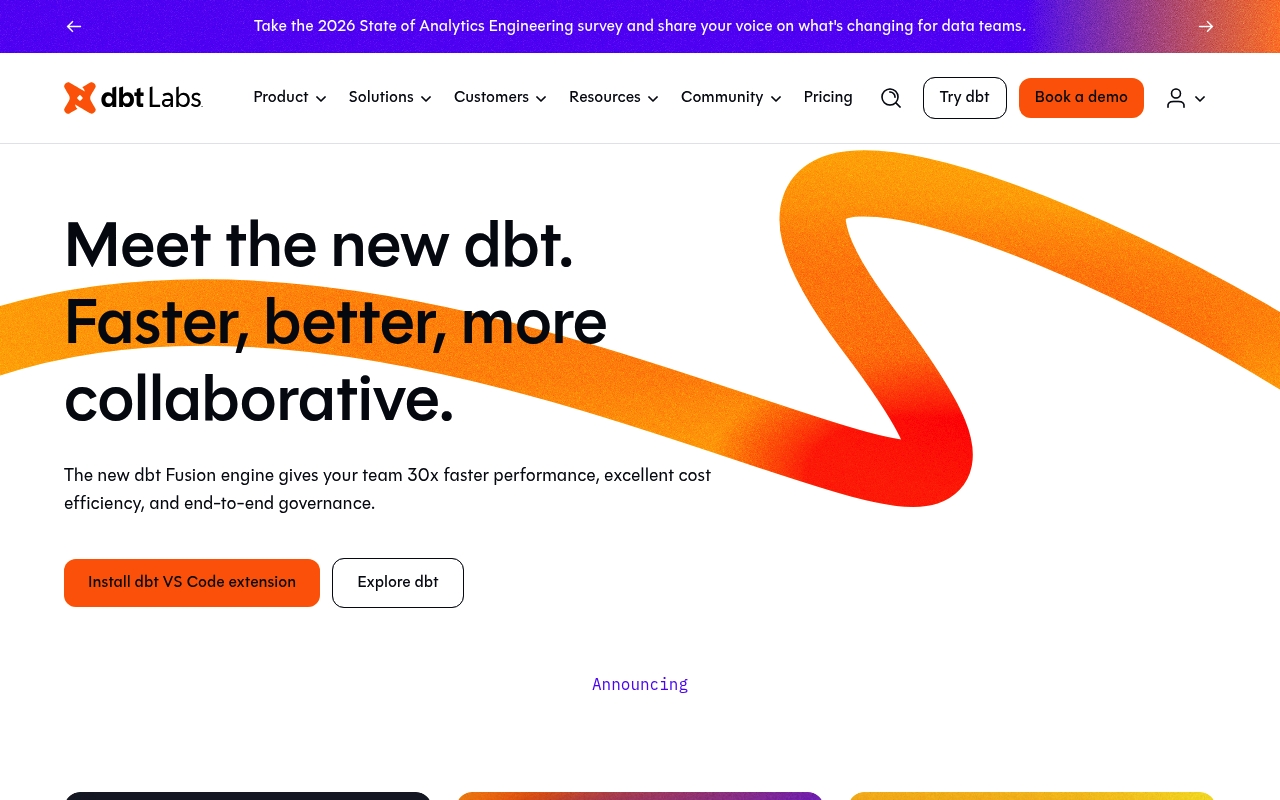
dbt is a powerful, widely-adopted transformation tool that lets data teams build reliable, governed data pipelines using SQL and version control.
Key Features:
- SQL Transforms - Write modular SQL models that transform raw data into analytics-ready datasets.
- Built-In Testing - Validate data quality with schema tests, custom assertions, and freshness checks.
- Lineage and Docs - Auto-generate documentation and data lineage graphs for full pipeline visibility.
- Fusion Engine - Experience lightning-fast parse times and live error detection with the next-gen engine.
- dbt Copilot - Accelerate development with AI-powered assistance for data modeling tasks.
- Version Control - Manage transforms as code with Git-based workflows and CI/CD integration.
Whether you're an analytics engineer, data scientist, or BI developer, dbt provides the platform to deliver trusted, well-documented data faster.
Web scraping workflow
How to use dbt in a web scraping pipeline
dbt transforms data already present in a supported data platform and organizes those transformations as a maintained project. In scraping, it belongs after extraction and loading, where inconsistent source records become analytical models.
A practical workflow
- A separate scraper and loader populate raw tables with entity keys, source URLs and observation times.
- Build dbt models that normalize fields, join reference data and distinguish current records from historical observations.
- Run relevant tests and publish curated models for reports or application consumers, keeping lineage back to the raw inputs.
When it fits
Use it when cleaning rules should be versioned, reviewed and shared across several downstream datasets. A model can make source-specific differences explicit instead of repeating the same cleanup in every dashboard query.
Boundaries
dbt does not fetch pages or provide the initial ingestion path. The chosen adapter and data platform determine supported behavior. Tests can enforce selected expectations, but they cannot establish that every extracted value reflects the source page; preserve capture references and review parser changes separately.
Growing a website? Track its keywords, Google rankings, Search Console insights, and share of voice with bisibility. Free during beta.
Our productRepository
dbt-labs/dbt
Stars
14KForks
2.6KLast commit
2026-10-15License
Apache-2.0Language
Rust
Metrics recorded 2026-10-16
Repository details
License source: Repository license file
Frequently asked questions
Is dbt considered an ETL tool?
dbt transforms data that has already been loaded into a data platform. It is usually part of an ELT pipeline; separate tools handle extraction and loading.
Sources (checked ): What is dbt?
What programming language does dbt use?
SQL is the main language for dbt models. dbt adds dependency management, tests and documentation around those transformations. Projects also use Jinja templates and YAML configuration; Python models are available on supported data platforms.
Sources (checked ): dbt framework; Python models
Is dbt written in SQL or Python?
dbt models use SQL, with Python models supported on specific platforms. The engine is a separate question: dbt’s current documentation identifies dbt v2 as the Rust-based generation and dbt v1 as the original Python-based generation.
Sources (checked ): dbt versions and engine; Python models
Sources
Verified against the dbt-labs/dbt-core repository and the PyPI package.