
DuckDB
DuckDB is an in-process analytical database that lets you query scraped CSV, Parquet, and JSON files with fast SQL, no server required.
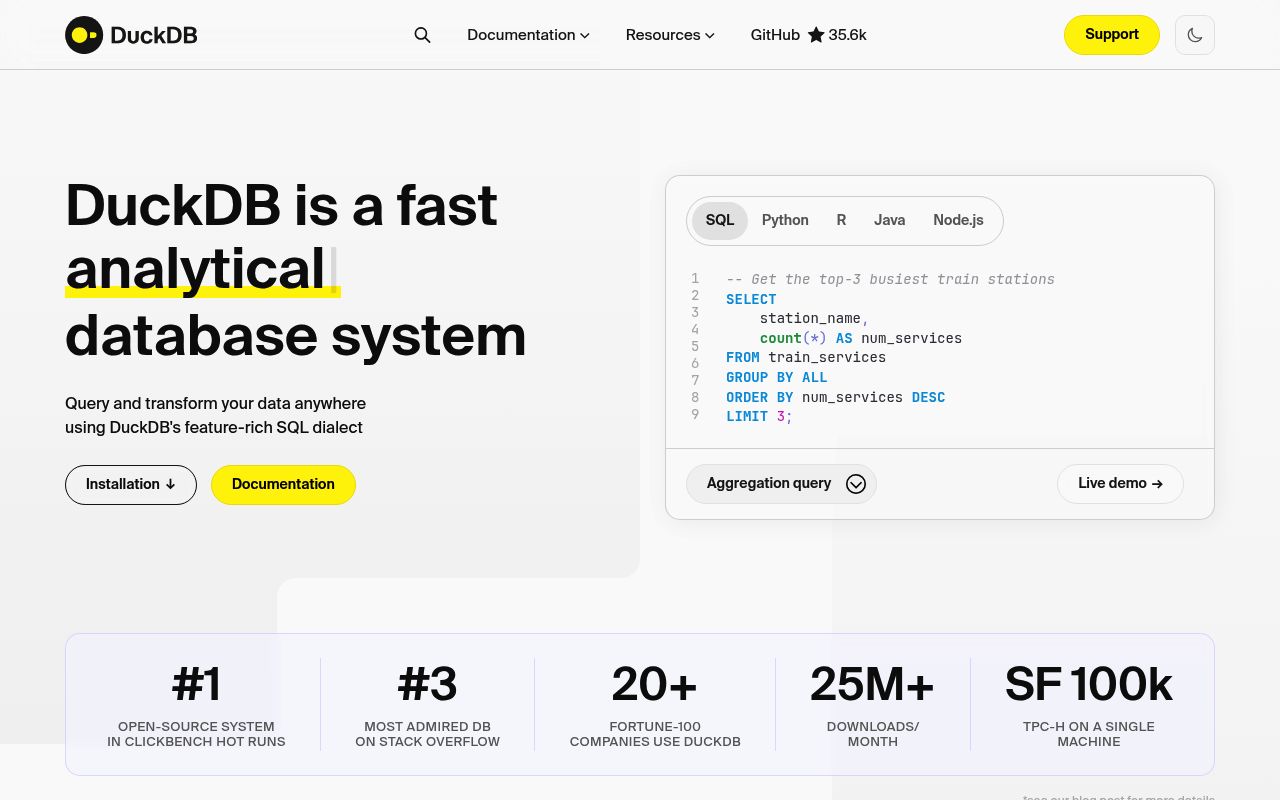
DuckDB is a fast, embeddable analytical database that brings SQL analytics directly to your application.
Key Features:
- Zero Infrastructure - Run analytical queries without deploying or managing a database server.
- Direct File Queries - Query CSV, Parquet, and JSON files in place without importing or loading.
- Columnar Engine - Vectorized execution delivers fast aggregations and joins on large datasets.
- Rich SQL Dialect - Window functions, CTEs, and nested types for complex data transformations.
- Language Bindings - Native support for Python, R, Node.js, Java, and more.
Whether you're exploring scraped datasets locally, transforming crawl outputs in a pipeline, or prototyping analytics, DuckDB provides powerful SQL analysis with zero setup overhead.
Web scraping workflow
How to use DuckDB in a web scraping pipeline
DuckDB queries files and tables through SQL, including collected CSV and Parquet exports. It is useful for inspecting a crawl's output locally before building a larger data-serving system.
A practical workflow
- Use Scrapy or another fetcher to save normalized records with source URLs and collection timestamps.
- Open the exported files in DuckDB and query duplicate keys, missing values, field distributions or differences between two collection runs.
- Export a cleaned table or a quality report for loading elsewhere, retaining the original input files for comparison.
When it fits
Choose it for exploratory analysis, repeatable checks and file-based transformations of scraped datasets. SQL over saved files lets an analyst investigate extraction changes without running the crawl again or operating a separate database server for the task.
Boundaries
DuckDB does not supply site-specific acquisition, JavaScript rendering or extraction rules. Available memory, disk and query design still constrain local work. Treat source files as untrusted data, validate their schema and preserve provenance when joining records from different collection dates.
Quick verdict
DuckDB is for teams that want fast SQL analytics directly over scraped files. It is not a crawler, browser automation tool, or hosted warehouse.
- Best for
- SQL over scraped files
- Embedded analytics in pipelines
- Local data exploration
- Python and JS workflows
- Not ideal for
- Crawler or browser automation
- Hosted analytics procurement
- Shared operational databases
- Last verified
- Jun 26, 2026
Key facts
- SDKsPython, JavaScript, Java, Rust, and C#Project docs
Growing a website? Track its keywords, Google rankings, Search Console insights, and share of voice with bisibility. Free during beta.
Our productRepository
duckdb/duckdb
Stars
42.2KForks
3.9KLast commit
2026-10-15License
MITLanguage
C++
Metrics recorded 2026-10-16
Repository details
License source: Repository license file
Frequently asked questions
What do people use DuckDB for?
DuckDB is an analytical SQL database used to query and aggregate data, including files and in-memory tables. It can run inside an application or through its command-line client, without a separate database server for those local uses.
Sources (checked ): DuckDB overview and license; DuckDB Python client
Is DuckDB free?
DuckDB is an analytical database released under the MIT license. The database is free to use; commercial hosting, support or other services built around it can have separate charges.
Sources (checked ): DuckDB overview and license
What language does DuckDB use?
You query DuckDB with SQL. Its engine is implemented primarily in C++, and client APIs let applications use it from languages including Python.
Sources (checked ): DuckDB overview and license; DuckDB Python client; DuckDB engine repository
Can DuckDB run in a browser?
Yes. DuckDB-Wasm compiles DuckDB to WebAssembly and exposes a JavaScript API for browser applications. Browser memory, threading and available extensions differ from a native DuckDB process.
Sources (checked ): DuckDB-Wasm
Can DuckDB read SQLite?
Yes. DuckDB’s SQLite extension can attach SQLite databases and query their tables. Follow the extension’s installation, loading and ATTACH instructions for your DuckDB version.
Sources (checked ): DuckDB SQLite extension
Does DuckDB have a GUI?
Yes. The ui extension opens a browser interface connected to a local native DuckDB instance. The interface is maintained by MotherDuck; its default query execution is local, while connecting to MotherDuck requires an explicit sign-in.
Sources (checked ): DuckDB UI extension
How much RAM does DuckDB use?
RAM use varies with the dataset and query plan. DuckDB’s documented memory_limit default is 80% of RAM, but that setting does not cap every allocation. Supported operations can spill intermediate data to disk, and some queries can still run out of memory.
Sources (checked ): DuckDB configuration; DuckDB workload tuning; DuckDB memory-limit scope
What are the disadvantages of using DuckDB?
DuckDB is designed for analytical queries, so evaluate workloads dominated by frequent small row updates separately. In in-process mode, read-write access to a database file uses one process; multiple writer threads can operate within it, but conflicting row updates can fail. Some larger-than-memory queries can still run out of memory.
Sources (checked ): DuckDB design; DuckDB concurrency; DuckDB workload tuning
Can DuckDB replace Snowflake?
DuckDB can handle analytical SQL workloads, but replacing a managed data platform also requires decisions about shared storage, concurrent users, access control and operations. Compare those needs with the specific DuckDB deployment and services you plan to operate.
Sources (checked ): DuckDB overview and license; Snowflake architecture
Sources
Verified against the duckdb/duckdb repository and the PyPI package.
Source notes
Compiled from public repository and package data; check DuckDB's site for current details.