

DynamoDB
Amazon DynamoDB is a fully managed, serverless NoSQL database with single-digit millisecond performance for high-throughput scraping workloads.
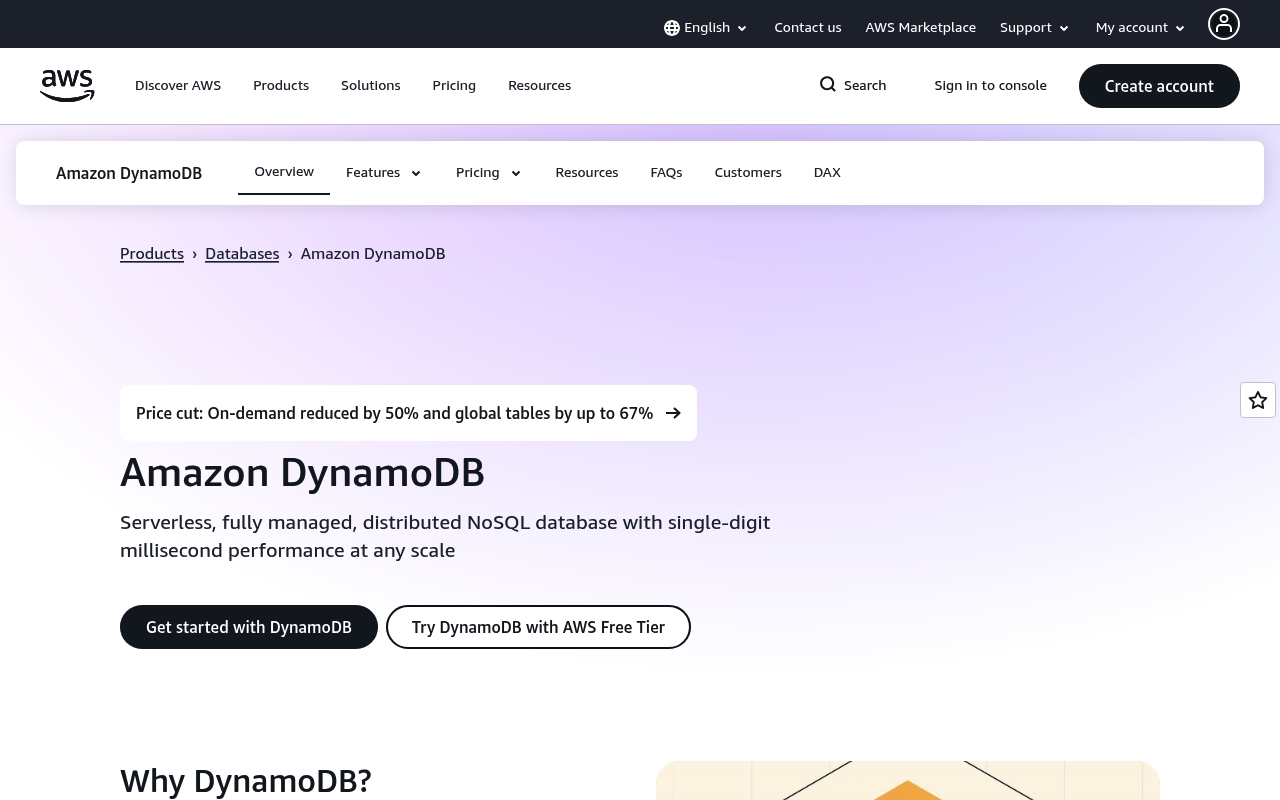
DynamoDB is a fully managed, serverless NoSQL database from AWS built for single-digit millisecond performance for supported workloads.
Key Features:
- Auto-Scaling - Automatically adjust read and write capacity to match scraping workload demands.
- Global Tables - Replicate data across AWS regions for low-latency global access.
- Streams - React to data changes in real time with event-driven processing pipelines.
- Serverless Operation - No servers to provision, patch, or manage, with built-in security and backups.
Whether you're storing scraped product data, managing URL queues, or building high-throughput data pipelines, DynamoDB provides reliable performance with zero infrastructure overhead.
Web scraping workflow
How to use DynamoDB in a web scraping pipeline
Amazon DynamoDB is a managed NoSQL database for application data. In a scraping pipeline, it can store the current collected state of an entity when the application reads records through predictable keys.
A practical workflow
- A separate scraper extracts an entity identifier, source URL, observation time and validated fields.
- Your application chooses a stable item key and writes the latest accepted observation through the DynamoDB API.
- A consumer reads the item to serve current data, while any required raw capture or detailed history is stored through a separate archival design.
When it fits
Consider it for an AWS application that needs keyed access to collected records rather than ad hoc joins over an entire corpus. Define how a recrawl updates an existing entity before loading the first production batch.
Boundaries
DynamoDB does not discover URLs or extract HTML. Key design, concurrency control, retention and duplicate handling belong to your application. An archived client repository is not evidence that the hosted DynamoDB service is retired; evaluate the service and the chosen SDK separately.
Growing a website? Track its keywords, Google rankings, Search Console insights, and share of voice with bisibility. Free during beta.
Our productOfficial SDK
aws/aws-sdk-js
Stars
7.6KForks
1.5KLast commit
2025-12-09License
Apache-2.0Language
JavaScript
Metrics recorded 2026-10-16
Repository details
License source: Repository license file
Frequently asked questions
What is DynamoDB used for?
Amazon DynamoDB is an AWS-managed key-value and document database. Applications use it for access patterns that can be expressed through partition keys, sort keys and indexes. Design those access patterns and capacity requirements before choosing a table layout.
Sources (checked ): Amazon DynamoDB introduction; DynamoDB data modeling
What are the disadvantages of DynamoDB?
DynamoDB data modeling is driven by access patterns rather than relational joins. Items have a 400 KB size limit, including attribute names and values. Queries depend on key and index design; scans and extra indexes can add capacity and cost requirements.
Sources (checked ): Amazon DynamoDB introduction; DynamoDB constraints; DynamoDB data modeling; DynamoDB pricing
Is DynamoDB just MongoDB?
No. DynamoDB is an AWS-managed key-value and document service; MongoDB is a document database with its own query, indexing and deployment model. Compare access patterns, query flexibility, deployment control and costs for the application.
Sources (checked ): Amazon DynamoDB introduction; MongoDB data modeling
Why use DynamoDB instead of PostgreSQL?
DynamoDB may fit an application needing a managed AWS key-value/document service with known access patterns. PostgreSQL provides a relational model and SQL querying, including joins. Choose according to data relationships, query needs and operating responsibilities.
Sources (checked ): Amazon DynamoDB introduction; DynamoDB data modeling; PostgreSQL relational concepts
Which is cheaper, DynamoDB or RDS?
There is no fixed cost winner. DynamoDB pricing depends on the selected capacity mode, reads, writes, storage and additional services. Amazon RDS pricing depends on engine, deployment, instances or serverless capacity and storage. Estimate both against the same workload and availability needs.
Sources (checked ): DynamoDB pricing; Amazon RDS pricing
Sources
Verified against the aws/aws-sdk-js repository.