
Great Expectations
Great Expectations helps data teams validate, document, and monitor data quality across pipelines with automated testing and observability.
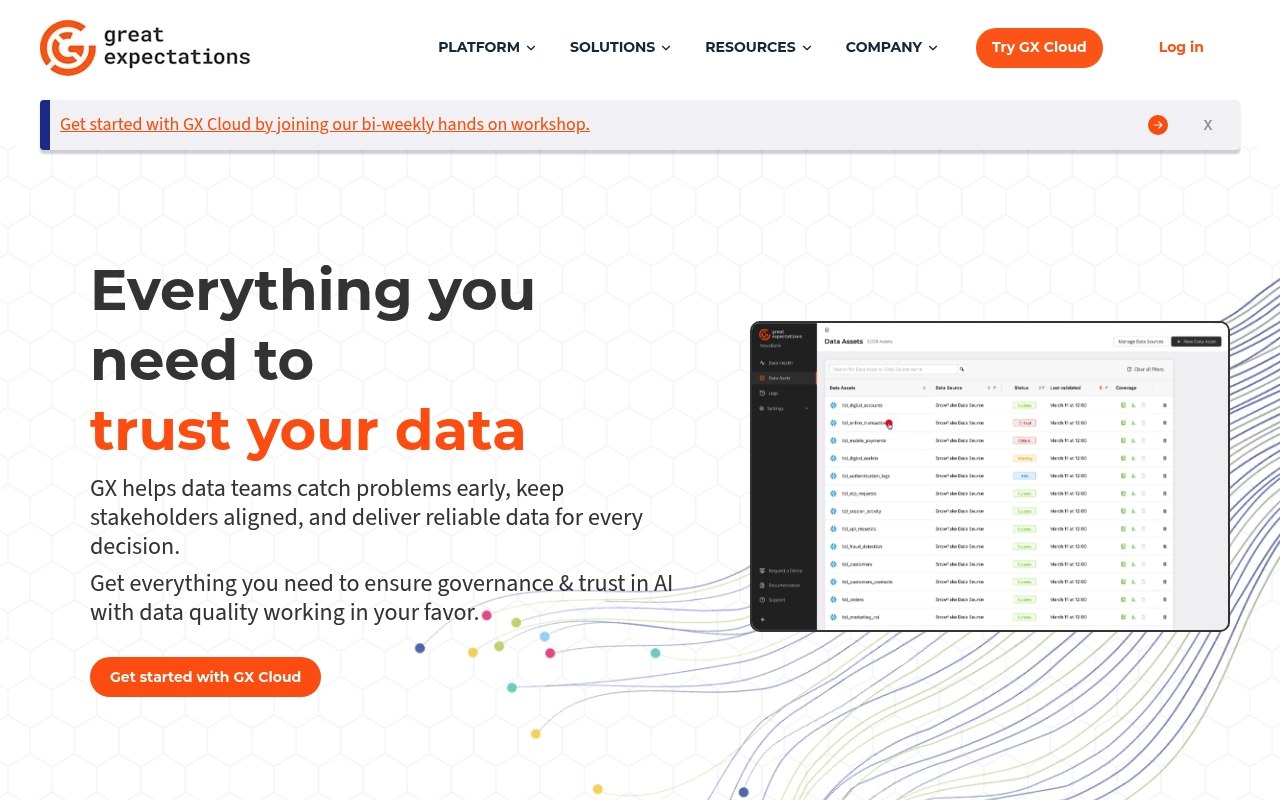
Great Expectations is a comprehensive, open-source data quality platform that helps teams validate and monitor data across every stage of their pipelines.
Key Features:
- Expectation Tests - Define data quality rules that validate schema, values, and statistical properties.
- ExpectAI - Auto-generate validation tests using AI to accelerate pipeline coverage.
- Real-Time Monitoring - Track data health continuously and get alerts before bad data causes damage.
- Pipeline Integration - Plug into CI/CD, orchestrators, and existing data workflows seamlessly.
- Collaboration Tools - Share data quality insights between technical and business teams.
- GX Cloud - Get started in minutes with a managed platform requiring zero infrastructure.
Whether you're validating ingested data, monitoring pipeline health, or enforcing governance, Great Expectations provides the tools to trust your data end to end.
Web scraping workflow
How to use Great Expectations in a web scraping pipeline
Great Expectations expresses data-quality expectations and evaluates data against them. A scraping pipeline can use those checks as a gate between extraction and publication when a source layout changes unexpectedly.
A practical workflow
- A separate scraper writes a structured batch with source and collection-run identifiers.
- Define expectations for the fields that matter, such as required values, acceptable types or known value ranges, and validate the batch.
- Send passing data to the destination and preserve failed results with enough context for an operator to investigate the source captures.
When it fits
Use it when a technically successful crawl can still return unusable data. Recorded checks make the publication decision explicit and help distinguish an expected source change from a broken selector or parser.
Boundaries
Only the expectations you define are checked. A passing validation does not prove factual truth, completeness or permission to use the data. Choose checks that reflect the workload, review legitimate exceptions and keep the raw observations instead of silently discarding every unexpected value.
Growing a website? Track its keywords, Google rankings, Search Console insights, and share of voice with bisibility. Free during beta.
Our productRepository
fivetran/great_expectations
Stars
11.9KForks
1.9KLast commit
2026-10-12License
Apache-2.0Language
Python
Metrics recorded 2026-10-16
Repository details
Last push: 2026-10-14
License source: Repository license file
Frequently asked questions
Is Great Expectations a Python library?
GX Core is Great Expectations’ Python library for defining data-quality requirements as Expectations and validating data against them. It supports both exploratory checks and validation workflows in production pipelines.
Sources (checked ): GX Core overview
How can I use Great Expectations to validate data?
Connect your data, define the checks in an Expectation Suite, then run a Validation Definition against a batch of data. Review the results to see which expectations passed or failed. Checkpoints can automate repeated validations and follow-up actions.
Sources (checked ): GX Core validation workflow
Sources
Verified against the great-expectations/great_expectations repository and the PyPI package.