
MinIO
MinIO is a self-hosted, S3-compatible object store for files, datasets, and media, with distributed storage and erasure coding. Its repository is archived.
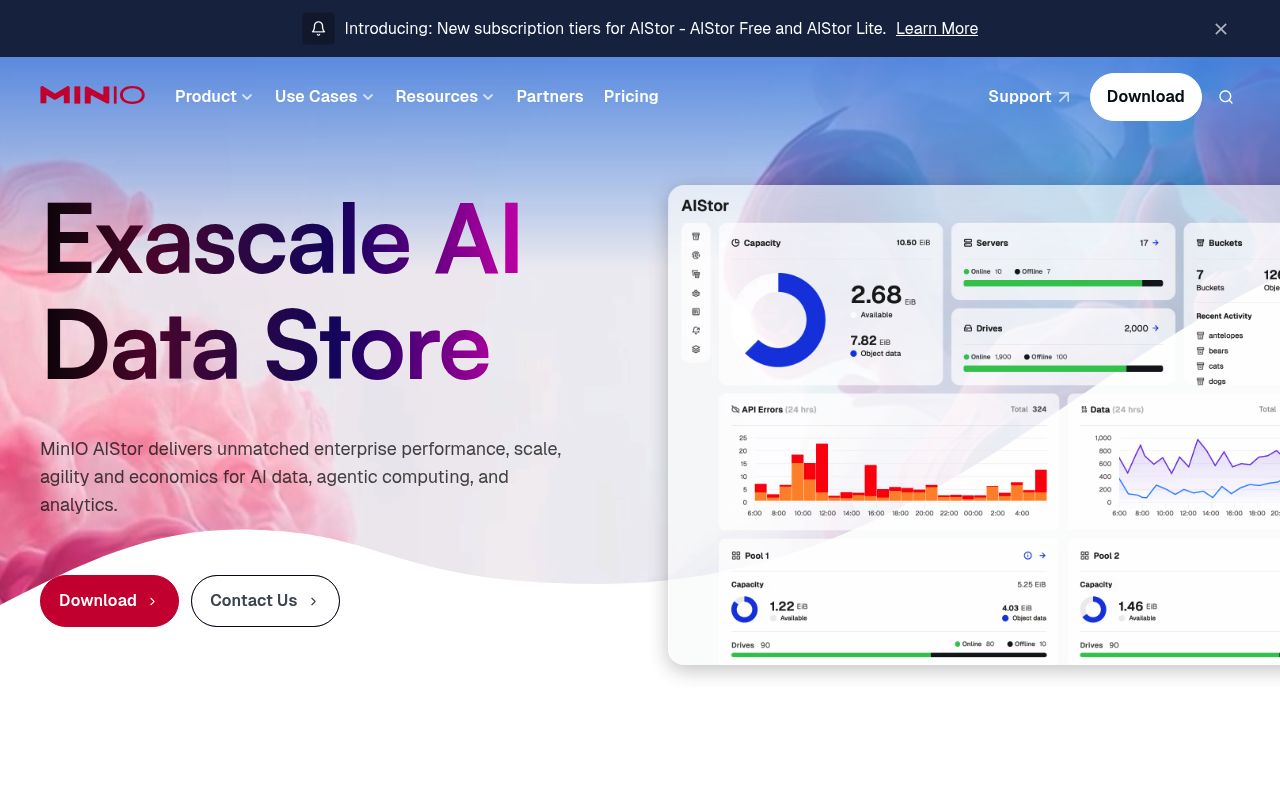
MinIO is a high-performance, S3-compatible object store designed for exascale data infrastructure.
Key Features:
- S3 Compatibility - Supports S3-compatible clients; check the operations your client requires.
- Distributed Storage - Scale deployments across clusters and data centers as storage requirements grow.
- Self-Hosted Control - Deploy on-premises or in any cloud, keeping full ownership of your scraped data.
- Erasure Coding - Protect stored data through configurable erasure coding.
- High Throughput - Support bulk data access for AI training pipelines and bulk data ingestion.
The archived community edition requires a maintenance plan for storing datasets, media, and pipeline assets; commercial AIStor has separate terms.
Maintenance: The MinIO community repository was archived on 2026-04-25 and its README states that it is no longer maintained. AIStor is a separate commercial offering.
Web scraping workflow
How to use MinIO in a web scraping pipeline
The archived MinIO community repository describes an S3-compatible object-storage server. In an existing scraping installation, its useful role is preserving raw captures and exports while the team plans a supported storage path.
A practical workflow
- Inventory the buckets and manifests used by the current crawler, including source URLs, object keys and capture versions.
- Keep acquisition and parsing connected through those stored objects while testing the application's required storage operations against the intended replacement.
- Validate transferred objects and update consumers through a controlled migration, retaining references that let extracted records resolve to their original captures.
When it fits
This is an existing-system or migration pattern, not a recommendation to start a new deployment from the archived community repository. Original captures can remain useful even when the software that stored them needs replacement.
Boundaries
The repository is read-only and states that it is no longer maintained. Separate AIStor offerings have their own scope and terms; do not infer support from the old code. Storage does not fetch or parse pages, and a migration needs independently verified data and access controls.
Quick verdict
MinIO community is an archived S3-compatible object store for existing deployments. Its README states it is no longer maintained. Evaluate maintenance and support separately from its AGPL-3.0 license.
- Best for
- Self-hosted object storage
- S3-compatible scraping archives
- Data and AI pipelines
- Existing deployments with a maintenance plan
- Not ideal for
- Fully managed storage
- Permissive-license requirements
- New deployments requiring upstream maintenance
- Last verified
- Jun 26, 2026
Key facts
- SDKsPython, JavaScript, Go, Java, Rust, and C# clientsProject docs
Growing a website? Track its keywords, Google rankings, Search Console insights, and share of voice with bisibility. Free during beta.
Our productRepository
minio/minio
Stars
61.3KForks
8.2KLast commit
2026-02-12License
AGPL-3.0Language
Go
Metrics recorded 2026-10-16
Repository details
Last push: 2026-04-24
License source: Repository license file
Frequently asked questions
What is MinIO used for?
MinIO provides S3-compatible object storage for files and datasets on infrastructure you operate. Its Community and AIStor editions have different licensing and maintenance status.
Sources (checked ): MinIO archived repository and README
Has MinIO been discontinued?
The minio/minio Community repository was archived on April 25, 2026 and is read-only. That establishes the repository’s status, not the discontinuation of every MinIO product. The vendor continues to present AIStor separately.
Sources (checked ): MinIO archived repository and README; Current MinIO commercial product
Is MinIO the same as S3?
MinIO is software for running object storage with an S3-compatible API. Amazon S3 is an AWS-managed storage service. API compatibility can support similar clients, but deployment, administration and supported features differ.
Sources (checked ): MinIO archived repository and README; Amazon S3 overview
Can I use MinIO for free?
The archived Community source is available under AGPLv3, subject to that license’s conditions. Infrastructure and maintenance remain your responsibility. AIStor Free and AIStor Enterprise are separate editions with their own terms.
Sources (checked ): MinIO archived repository and README
Can you run MinIO locally?
The archived Community README describes building MinIO from source and running a local server, including a Docker image you build yourself.
Sources (checked ): MinIO archived repository and README
Sources
The MinIO community repository was archived on 2026-04-25 and its README states that it is no longer maintained. AIStor is a separate commercial offering. Status checked on 2026-10-01.
Source notes
Archive and maintenance status rechecked against github.com/minio/minio on 2026-10-01. Historical popularity counts retain their original review date; AIStor is a separate commercial offering.