
MongoDB
MongoDB is a flexible document database that stores scraped data as JSON-like documents, making it easy to ingest varied web content.
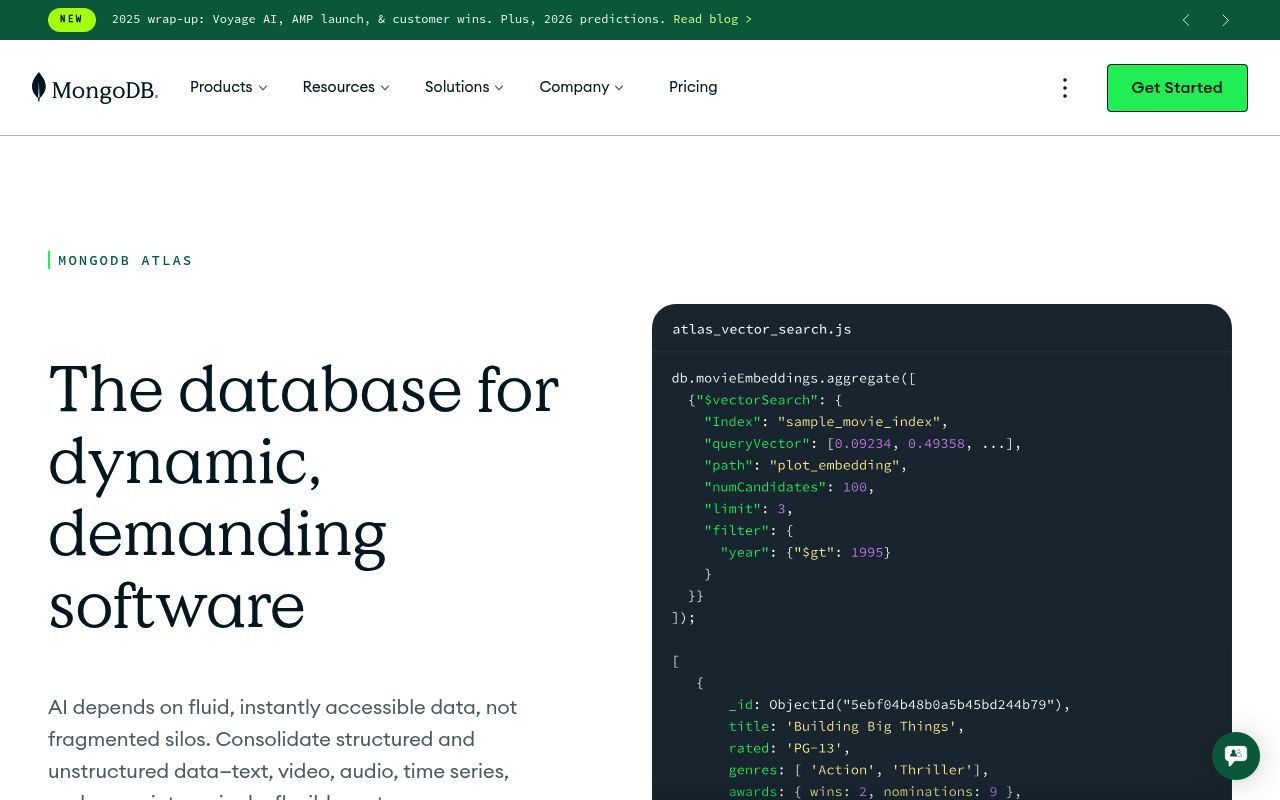
MongoDB is a flexible, scalable document database that makes it easy to store and query diverse scraped data.
Key Features:
- Schema Flexibility - Store scraped data with varying structures as JSON-like documents without rigid schemas.
- Powerful Queries - Filter, aggregate, and transform ingested data with an expressive query language.
- Horizontal Scaling - Distribute data across shards to handle growing scraping volumes.
- Atlas Search - Build full-text search and vector search directly on your document collections.
- Change Streams - React to new scraped data in real time with event-driven pipelines.
Whether you're storing product listings, archiving web pages, or building a content aggregator, MongoDB provides the flexibility to ingest any data shape at scale.
Licensing: MongoDB Community Server uses the Server Side Public License (SSPL), which is not OSI-approved. Drivers and MongoDB Atlas have separate licensing and service terms.
Web scraping workflow
How to use MongoDB in a web scraping pipeline
MongoDB stores records as BSON documents, including nested fields and arrays. It can hold extracted page entities whose structure varies across source sites while preserving a consistent envelope of provenance fields.
A practical workflow
- A separate HTTP or browser scraper emits a record with an entity key, source URL, capture time and extracted attributes.
- Your loader validates the shared fields and writes the document using an explicit policy for updating current state or retaining observations.
- Application queries read those documents, while references to raw captures support debugging when a source layout changes.
When it fits
Use it when collected entities naturally contain nested values, such as product variants or article metadata. A document model can retain that shape without making every source-specific field a separate relational table.
Boundaries
Flexible document structure does not remove the need for validation, indexes or identity rules. MongoDB does not fetch or render pages. Keep oversized raw artifacts outside the record model, and distinguish missing extraction fields from legitimate empty values before overwriting a previously useful document.
Quick verdict
MongoDB fits teams storing messy scraped data as flexible documents with strong querying and scale. It is not a scraper, crawler, browser automation tool, or managed extraction API.
- Best for
- JSON-shaped scraped records
- Flexible fields across sources
- Aggregation after collection
- Search and change-stream workflows
- Not ideal for
- Fetching or rendering pages
- Proxy rotation or extraction
- Strict relational-only schemas
- Last verified
- Jun 26, 2026
Key facts
- SDKsPython, JavaScript, Go, Java, Ruby, PHP, Rust, and C# packagesProject docs
Growing a website? Track its keywords, Google rankings, Search Console insights, and share of voice with bisibility. Free during beta.
Our productRepository
mongodb/mongo
Stars
28.6KForks
5.8KLast commit
2026-10-15License
SSPL-1.0 (community source)Language
C++
Metrics recorded 2026-10-16
Repository details
License source: Repository license file
Frequently asked questions
What is MongoDB and what is it used for?
MongoDB is a document database that stores records as BSON documents. Applications can embed related values or reference other documents and query collections.
Sources (checked ): MongoDB data modeling
Is MongoDB better than SQL?
SQL is a query language, so it is not a single competing database. MongoDB’s document model differs from the table-and-relation model used by many SQL databases. Choose according to access patterns, relationships, query requirements and operational constraints.
Sources (checked ): MongoDB data modeling; PostgreSQL relational concepts
What are the disadvantages of MongoDB?
Document design and indexes still require planning. MongoDB limits an individual BSON document to 16 mebibytes, so unbounded embedded data needs another design, and larger file content can use GridFS. Evaluate joins, transactions and storage against your actual workload.
Sources (checked ): MongoDB data modeling; MongoDB limits
Sources
Source-available licensing checked against the published project license on 2026-10-01; cloud and commercial terms are separate.
Source notes
License classification rechecked on 2026-10-01; historical popularity counts retain their original review date. Compiled from public repository and package data; check MongoDB's site for current details.