
OpenSearch
OpenSearch is an Apache 2.0-licensed search and analytics suite that lets you ingest, search, visualize, and analyze scraped data at scale.
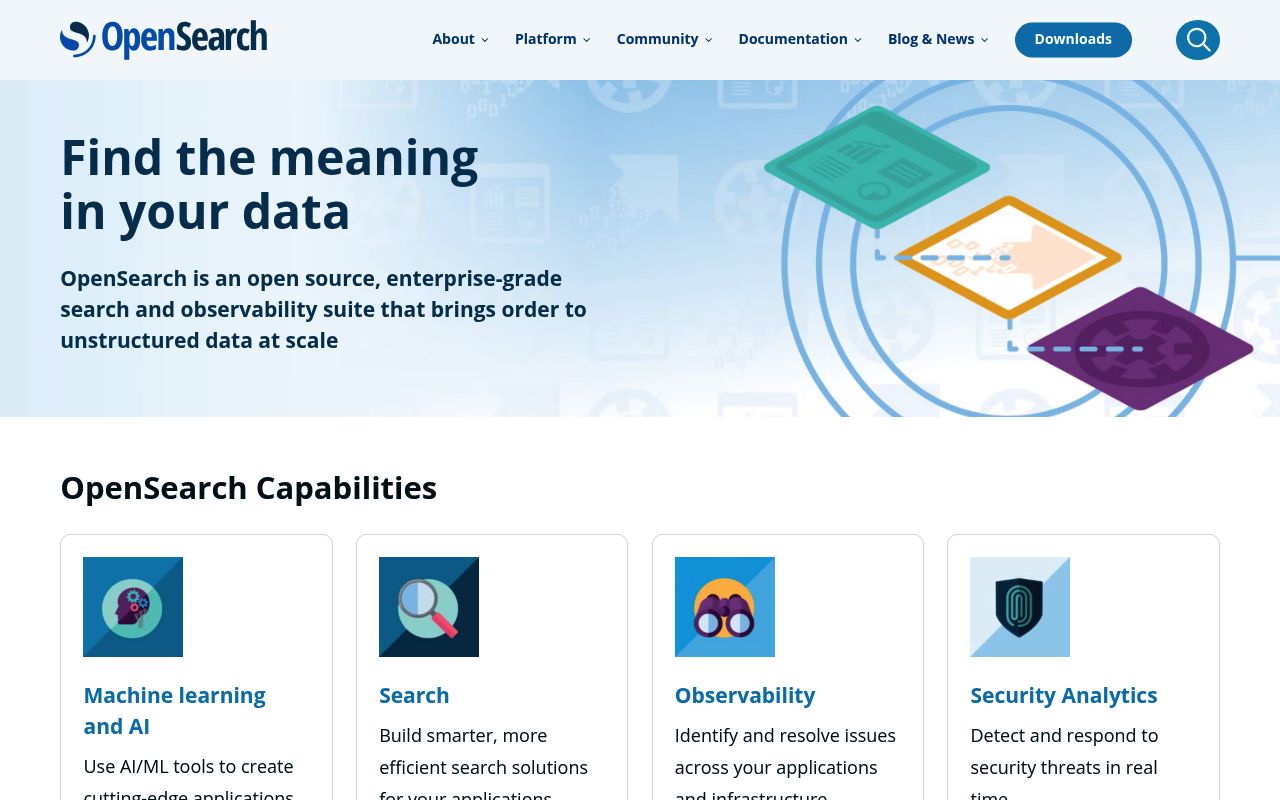
OpenSearch is a community-driven, open-source search and analytics suite licensed under Apache 2.0.
Key Features:
- Full-Text Search - Index and query scraped content with powerful relevancy scoring and aggregations.
- Dashboards - Visualize and explore ingested data with built-in interactive dashboards.
- Machine Learning - Detect anomalies and run vector search with integrated ML capabilities.
- Security Built-In - Fine-grained access control, encryption, and audit logging out of the box.
- Observability - Ingest and analyze logs, traces, and metrics from scraping infrastructure.
Whether you're building search over scraped content, monitoring crawl infrastructure, or analyzing extracted data at scale, OpenSearch provides a fully open, enterprise-ready platform.
Web scraping workflow
How to use OpenSearch in a web scraping pipeline
OpenSearch ingests documents into indexes and provides a Bulk API for loading multiple documents. It can serve search over a scraped corpus after acquisition and field extraction have already happened.
A practical workflow
- A separate scraper emits normalized documents containing source URLs, stable identifiers and collection timestamps.
- A loader sends batches through the Bulk API, inspects individual operation outcomes and records failures for retry or review.
- A retrieval application queries the index and links matching records to their original sources or canonical stored documents.
When it fits
Consider it when collection produces batches that need a shared search layer rather than one request per individual document. Keeping a load manifest helps identify which records reached the index and which need reprocessing.
Boundaries
OpenSearch does not provide arbitrary web collection merely because it accepts documents. Configure mappings, access controls and resource limits separately. A successful batch request must not hide failed individual operations, and source updates or deletions need to propagate through your indexing process deliberately.
Growing a website? Track its keywords, Google rankings, Search Console insights, and share of voice with bisibility. Free during beta.
Our productRepository
opensearch-project/OpenSearch
Stars
13.9KForks
3KLast commit
2026-10-15License
Apache-2.0Language
Java
Metrics recorded 2026-10-16
Repository details
License source: Repository license file
Frequently asked questions
What is OpenSearch used for?
OpenSearch indexes documents for search, aggregation and analytics. It supports application search, log analysis and vector retrieval, with OpenSearch Dashboards for visual exploration. You can operate the project yourself or use a managed service.
Sources (checked ): OpenSearch documentation
Is OpenSearch free to use?
OpenSearch is Apache-2.0 licensed. Running it requires infrastructure and operational resources, and commercial managed services have separate pricing. The project license does not make a hosted deployment free.
Sources (checked ): OpenSearch repository and license; Amazon OpenSearch Service
Is OpenSearch an AWS product?
OpenSearch is a community project supported by the OpenSearch Software Foundation, a Linux Foundation project. Amazon OpenSearch Service is AWS’s managed service for supported engines. Distinguish the open-source project from that hosted AWS offering.
Sources (checked ): OpenSearch Foundation; Amazon OpenSearch Service
Is OpenSearch the same as Elasticsearch?
No. OpenSearch began from the Apache-licensed Elasticsearch and Kibana codebase but is now a separate project with its own releases and features. Check client, plugin and index compatibility for the exact versions you plan to use.
Sources (checked ): OpenSearch repository and license; OpenSearch documentation; Elasticsearch documentation
Can OpenSearch be used as a database?
OpenSearch stores indexed documents and supports search and aggregation. That can serve a retrieval layer or a search-oriented data store, but assess transaction, query and durability requirements before treating it as a replacement for another database.
Sources (checked ): OpenSearch documentation
What are the downsides of using OpenSearch?
Self-managed OpenSearch requires operating a cluster, planning shards and indexes, and providing capacity for ingestion and queries. Features and compatibility vary by version and plugin. Search latency depends on mappings, query design and resource allocation rather than the product name alone.
Sources (checked ): OpenSearch documentation
What are some alternatives to OpenSearch?
Elasticsearch is another document search and analytics engine. Typesense and Meilisearch focus on application search with different APIs and operating models. Compare your required indexing, aggregations, relevance and deployment features before choosing or migrating.
Sources (checked ): OpenSearch documentation; Elasticsearch documentation; Typesense guide; Meilisearch overview
Sources
Verified against the opensearch-project/OpenSearch repository and the PyPI package.