
Polars
Polars is an open-source DataFrame library with a Rust-based query engine, columnar processing, lazy evaluation, and parallel execution.
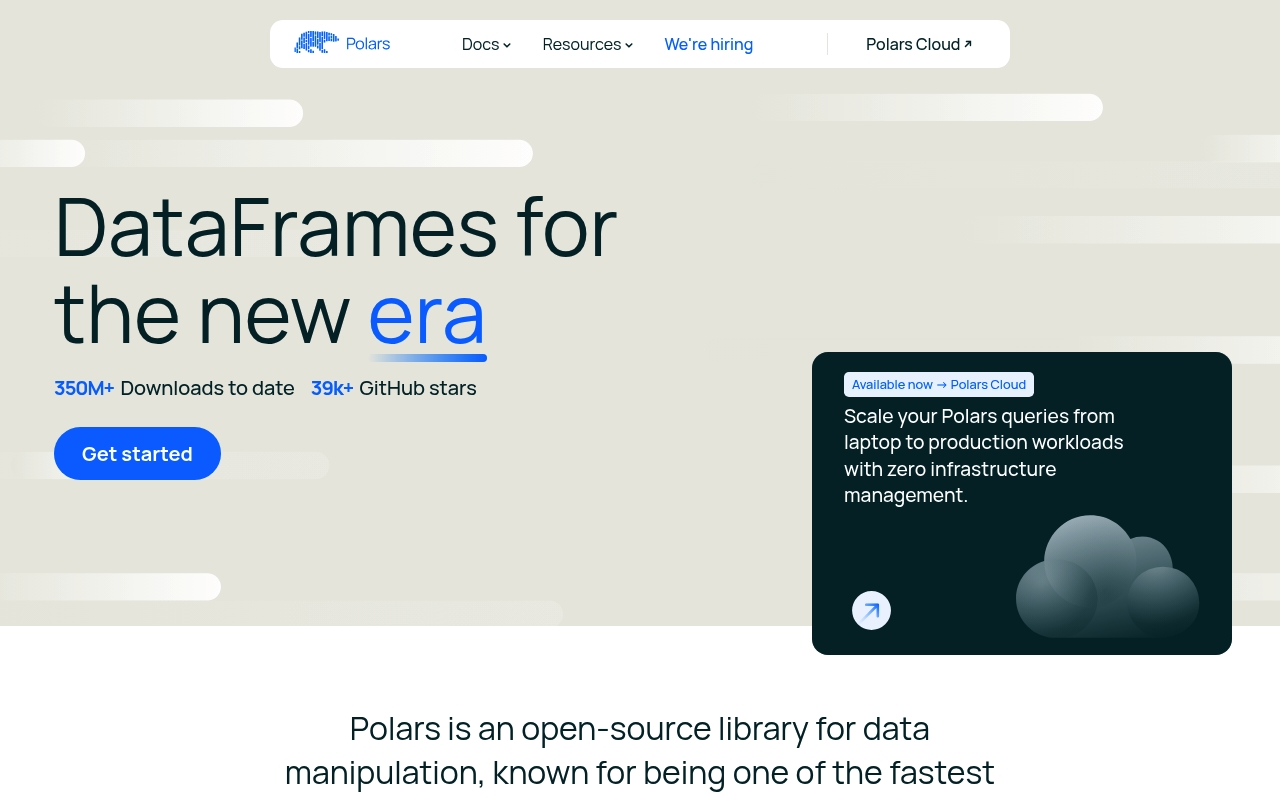
Polars is a blazing-fast, open-source DataFrame library that transforms how developers process and analyze data on a single machine.
Key Features:
- Rust-Powered Speed - Multi-threaded query engine with vectorized, columnar processing for parallel data processing.
- Lazy Evaluation - Optimize query plans automatically before execution for maximum efficiency.
- Expressive API - Write readable, performant data transformations with an intuitive, typed API.
- Out-of-Core Processing - Handle datasets larger than available memory with streaming execution.
- Polars Cloud - Scale from laptop to production workloads with zero infrastructure management.
Whether you're transforming scraped datasets, building data pipelines, or running batch analytics, Polars delivers parallel data processing with a developer-friendly API.
Web scraping workflow
How to use Polars in a web scraping pipeline
Polars processes tabular data and provides a lazy query interface. It can clean and combine structured scraping outputs before they are exported or loaded into another system.
A practical workflow
- A separate scraper produces files or records containing source identifiers, capture times and extracted fields.
- Build a Polars query that selects useful columns, normalizes values, joins reference data and separates rows that fail explicit checks.
- Execute the query and export the accepted table with a run identifier for downstream loading or analysis.
When it fits
Choose it for repeatable transformations over collected datasets when you need a programmatic table pipeline. Keeping the transformation definition separate from acquisition lets you reprocess saved captures after a cleaning rule changes.
Boundaries
Polars does not render pages or decide whether a scraped value is factually correct. Lazy evaluation means the actual work happens when the query executes, so handle execution failures before publishing output. Test assumptions about nulls, types and duplicate keys against representative records from every source.
Quick verdict
Polars fits engineering and data teams that need fast local DataFrame processing for scraped files. It is not a crawler or scraping API, so collection and operations stay separate.
- Best for
- Scraped data transformation
- Python, JavaScript, Rust workflows
- Batch files and analytics
- Self-hosted data pipelines
- Not ideal for
- Crawling or browser automation
- Hosted scraping APIs
- Visual scraping workflows
- Last verified
- Jun 26, 2026
Key facts
- Packagespolars on PyPI, nodejs-polars on npm, and polars on CargoProject docs
Growing a website? Track its keywords, Google rankings, Search Console insights, and share of voice with bisibility. Free during beta.
Our productRepository
pola-rs/polars
Stars
40.1KForks
3.2KLast commit
2026-10-15License
MITLanguage
Rust
Metrics recorded 2026-10-16
Repository details
License source: Repository license file
Frequently asked questions
What is a Polars DataFrame?
A Polars DataFrame is a two-dimensional table with named columns and typed values. Polars provides expressions for filtering, joining and aggregating that data. A LazyFrame represents a query plan that Polars can optimize before execution.
Sources (checked ): Polars pandas migration; Polars lazy execution
Is Polars better than pandas?
Choose according to your workload and existing code. Polars and pandas have different APIs and execution models; compare compatibility and representative queries before migrating.
Sources (checked ): Polars pandas migration; Polars engine comparison
Is Polars better than PySpark?
PySpark exposes Apache Spark for distributed data processing. Polars provides in-memory and streaming engines for a single machine, plus a distributed engine through Polars Cloud and Polars On-Prem. Compare deployment, existing integrations and your measured workload; neither is universally better.
Sources (checked ): Polars engine comparison
Is Polars more memory efficient than pandas?
Polars uses a columnar memory representation and can optimize lazy queries to avoid unnecessary work. Its streaming engine can process supported operations in batches. Actual memory use depends on data types, operations and execution mode, so measure your own workload.
Sources (checked ): Polars pandas migration; Polars lazy execution; Polars engine comparison
Sources
Verified against the pola-rs/polars repository and the PyPI package.
Source notes
Compiled from public repository, package, and project data; check the project site for current details.