

Memcached
Memcached is a free, high-performance distributed memory caching system that speeds up dynamic applications by caching scraped data in RAM.
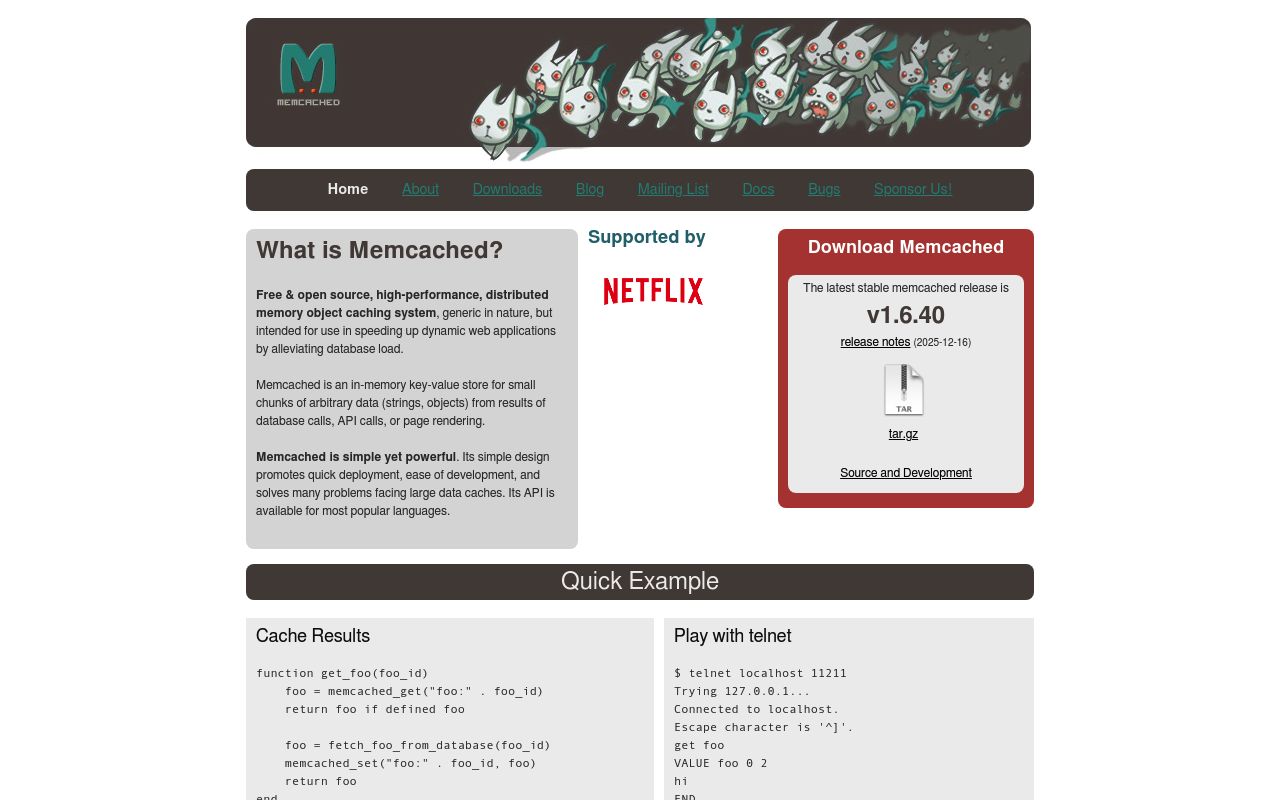
Memcached is a simple, high-performance distributed memory caching system designed to speed up dynamic applications.
Key Features:
- Multi-Threaded - Leverage multiple CPU cores for high-throughput concurrent access.
- Simple Protocol - Get, set, and delete operations with a straightforward text and binary protocol.
- Horizontal Scaling - Add nodes to distribute cache load linearly across your infrastructure.
- Language Agnostic - Client libraries available for Python, Node.js, Java, Go, and virtually every language.
Whether you're caching API responses, reducing database load from repeated queries, or speeding up scraped data retrieval, Memcached provides fast, reliable caching with minimal complexity.
Web scraping workflow
How to use Memcached in a web scraping pipeline
Memcached is a key/value cache that applications must explicitly use. In a scraping pipeline, it can hold disposable intermediate results so repeated processing does not always repeat the same local work.
A practical workflow
- A separate fetcher saves the authoritative response in durable storage and computes a content hash.
- Your parser checks a cache key derived from that hash and the parser version; on a miss, it parses the capture and stores a compact result with a chosen expiry.
- Validate and persist the record in the dataset, whether it came from the cache or a fresh parse.
When it fits
Use it when repeated requests or processing stages can reuse small derived values. Versioned keys prevent a changed parser from accidentally receiving a result produced by older extraction rules.
Boundaries
Memcached does not automatically cache a scraper or provide a durable collection queue. Entries can disappear, so a miss must remain a normal recoverable path. Keep raw documents and final records elsewhere, and do not use cache presence as the only proof that a URL was collected successfully.
Growing a website? Track its keywords, Google rankings, Search Console insights, and share of voice with bisibility. Free during beta.
Our productRepository
memcached/memcached
Stars
14.3KForks
3.4KLast commit
2026-07-10License
BSD-3-ClauseLanguage
C
Metrics recorded 2026-10-16
Repository details
Last push: 2026-09-11
License source: Repository license file
Frequently asked questions
What is Memcached used for?
Memcached is a key-value cache used to reduce repeated database queries or computation. Applications store serialized values under keys and retrieve them until they expire, are replaced or are evicted. The application decides how to populate and invalidate the cache.
Sources (checked ): Memcached design; Memcached user guide
What are the limitations of Memcached?
Cache entries can expire or be evicted when memory is needed, so applications must handle misses and reload data. Memcached servers do not replicate or coordinate with each other; client configuration determines how keys are distributed. Treat these cache semantics separately from durable storage requirements.
Sources (checked ): Memcached design; Memcached user guide
What is the difference between Redis and Memcached?
Memcached provides a key-value cache for serialized values. Redis provides data structures such as hashes, lists and sets, with additional messaging and persistence options. Choose according to the operations and durability behavior your application needs.
Sources (checked ): Memcached design; Redis data structures
Can I use ElastiCache with Memcached?
Yes. Amazon ElastiCache provides a managed Memcached option. Memcached is the cache engine, while ElastiCache is the AWS service that operates a supported deployment; service limits and pricing belong to AWS.
Sources (checked ): Memcached design; AWS ElastiCache overview
Is Memcached the same as Memcache?
Memcached is the cache server. In PHP, Memcache and Memcached are names of separate client extensions that connect to that server. Check which extension your application uses before applying its API examples or configuration.
Sources (checked ): Memcached design; PHP Memcache extension; PHP Memcached extension
Sources
Verified against the memcached/memcached repository and the npm package.